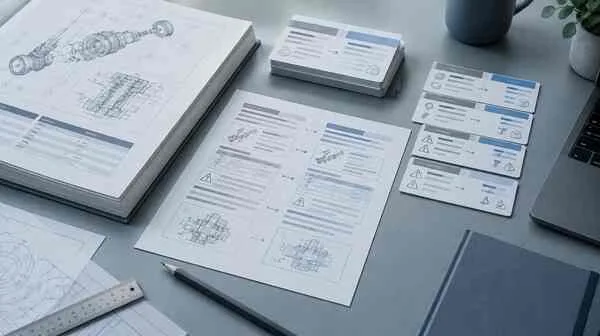
German technical and business copy needs consistent compounds, terminology and register. Long compounds can also affect navigation and table widths, so page design must be reviewed with the finished text.
Specify audience, locale and technical register
Agree on terminology for recurring product and legal concepts. Check formality, amounts, dates, units and defined names against the English source, then inspect headings and interface wrapping.
Check compound terms and noun consistency
Do not split or rephrase a compound if doing so changes a defined technical term.
Why test the final layout?
Longer terms can affect navigation, tables and mobile readability. The technical terminology guide explains how to keep approved terms usable in narrow interfaces.
Set rules for compounds, abbreviations and units
German work benefits from a terminology decision before long compounds appear across multiple screens or sections. Name the audience and level of formality, then define product nouns, legal terms and units once. Where the English source uses a short label, provide its function and character limit; a literal compound may not fit a navigation control.
Keep the German text clear at its final length
Proof the rendered version for hyphenation, heading wraps and table width. Check that abbreviations are understandable to the intended audience and that a formal address remains consistent. For regulated content, have the local owner approve required legal language rather than relying on a general-purpose glossary.
Example: expand a short English control label
Review mobile navigation and table headings after the German text is inserted. If a heading wraps, improve spacing or choose an approved concise label rather than deleting a qualifier from a technical or financial term.
Check German terminology and page fit together
Compound terms can be accurate and still break the interface.
- Approve recurring technical compounds in a glossary.
- Check menu widths, headings and hyphenation at target screen sizes.
- Compare every repeated term across the page and linked documents.
Questions about English to German translation
Should every compound be shortened to fit?
No. Preserve defined terms and adjust the layout or wording with approval.
Who approves legal phrases?
The responsible local legal or compliance owner.
Apply term checks to a device warning
A compound term may recur in a navigation label, technical warning and account setting. Choose the approved term once, then check that each occurrence still fits its context. If the label exceeds a button width, ask design to adjust the component or approve a concise form. Deleting a modifier to solve wrapping can alter which product feature the user sees.
| Term | Where it appears | Layout decision |
|---|---|---|
| Check the approved glossary entry. | Inspect headings, buttons and narrow layouts. | Test compounds and line breaks at real widths. |
Provide current terminology and interface context
Provide terminology decisions, audience formality, character limits and screenshots for headings or buttons. Keep compound terms stable across product, support and legal pages. Review in the rendered interface so layout changes can be addressed without deleting a modifier that distinguishes one feature from another.
What if a German label does not fit?
Shorten or restructure it only after confirming the approved term’s scope remains clear.